
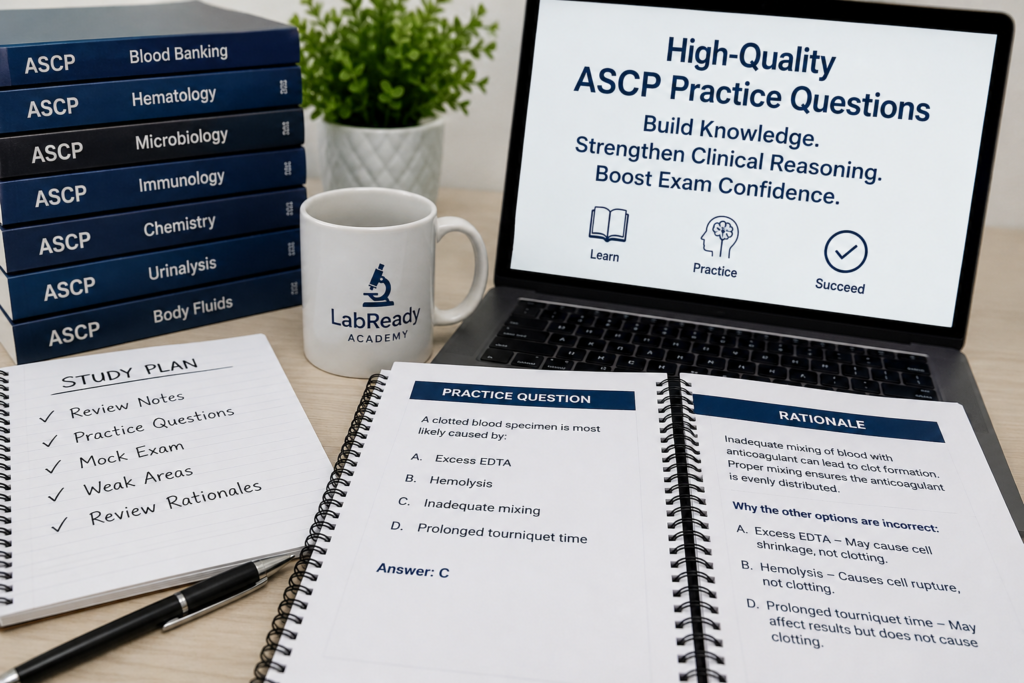
Preparing for the ASCP Board of Certification (BOC) examination can feel overwhelming, especially when you’re trying to decide which study resources to trust. One of the most common questions candidates ask is, “Where can I find high-quality ASCP practice questions?” In this guide, you’ll learn where to find reliable resources, how to evaluate them, and how to use them effectively throughout your preparationites.
A quick internet search will reveal hundreds of books, websites, downloadable PDFs, mobile apps, and question banks claiming to offer the best ASCP practice questions. Unfortunately, not every resource is equally effective. Some questions are outdated, overly simplistic, or fail to reflect the analytical thinking required on the actual examination. Others encourage memorization rather than developing the clinical reasoning skills that laboratory professionals rely on every day.
Choosing the right practice questions can make a meaningful difference in how effectively you prepare. High-quality questions help you identify knowledge gaps, strengthen problem-solving skills, improve confidence, and become comfortable answering exam-style questions under timed conditions.
If you’ve ever finished a set of practice questions and wondered,
“Am I actually preparing for the ASCP exam—or am I simply memorizing answers?”
you’re certainly not alone.
This article will help you understand what makes ASCP practice questions truly valuable, where to find reliable resources, and how to use them strategically throughout your study plan. More importantly, you’ll learn how to distinguish resources that genuinely improve your exam readiness from those that simply give the illusion of progress.
If you’re just beginning your preparation, you may also find it helpful to first understand how the ASCP examination is structured before choosing study resources.
➡ What Is the ASCP Exam? A Complete Guide for First-Time Candidates
For official information about the examination process and certification requirements, always refer to the ASCP Board of Certification (BOC).
Why Are ASCP Practice Questions So Important?
Many candidates naturally spend most of their study time reading textbooks, reviewing lecture notes, highlighting key facts, or watching educational videos. While these methods are valuable, they primarily represent passive learning. Passive learning helps you recognize information when you see it, but the ASCP examination requires something much more important—the ability to apply knowledge to unfamiliar clinical situations.
This is where ASCP practice questions become one of the most powerful tools in your preparation.
Practice questions transform studying from simply reading information into actively retrieving and applying knowledge. Educational research consistently shows that active recall—the process of forcing your brain to retrieve information—is one of the most effective ways to strengthen long-term memory and improve retention.
For Medical Laboratory Scientists, this is especially important because the ASCP examination rarely asks straightforward recall questions. Instead, candidates are expected to interpret laboratory results, recognize testing principles, troubleshoot analytical problems, and apply theoretical knowledge to real-world laboratory scenarios.
For example, rather than asking,
“What is the incubation temperature for organism X?”
a high-quality question may instead present:
- patient history,
- Gram stain findings,
- culture characteristics,
- biochemical test results,
and ask you to determine the most likely organism or the next appropriate laboratory test.
Questions like these evaluate understanding—not memorization.
High-quality practice questions help you:
Identify Knowledge Gaps
One of the greatest advantages of answering practice questions early in your study journey is discovering what you don’t yet know.
Many students believe they understand a topic after reading it several times. Practice questions often reveal otherwise.
For example, you may feel confident in Blood Banking until a compatibility-testing scenario exposes uncertainty about antibody identification or transfusion reactions.
Recognizing these weak areas early allows you to adjust your study plan before exam day.
This is one reason why many successful candidates combine practice questions with a structured review schedule such as a 12-Week ASCP Study Plan.
Strengthen Clinical Reasoning
The ASCP examination is designed to assess whether candidates can think like competent laboratory professionals—not simply recall isolated facts.
High-quality questions require you to:
- analyze patient information,
- interpret laboratory data,
- distinguish between similar diagnoses,
- recognize analytical errors,
- choose the most appropriate next step.
These are exactly the decision-making skills used in everyday laboratory practice.
As practicing laboratory professionals quickly learn, patient results rarely arrive with obvious answers. The examination reflects this reality.
Improve Time Management
Knowledge alone does not guarantee success.
Many candidates know the correct answer but struggle because they spend too much time analyzing individual questions.
Regular practice under timed conditions helps you:
- become familiar with question formats,
- recognize common testing patterns,
- improve decision-making speed,
- reduce unnecessary second-guessing.
Later in your preparation, you should gradually transition from individual practice questions to full-length ASCP practice tests.
➡ How Should You Use an ASCP Practice Test to Improve Your Score?
Reduce Examination Anxiety
One of the most overlooked benefits of practice questions is the confidence they build.
Exam anxiety often comes from uncertainty.
Questions like:
“What if the real exam is much harder?”
“What if I freeze during the examination?”
are common among candidates.
Repeated exposure to realistic practice questions helps replace uncertainty with familiarity.
Instead of worrying about what the examination might look like, you’ll already have experience thinking through similar clinical scenarios.
Reinforce Long-Term Learning
Many students mistakenly believe that completing hundreds of questions automatically leads to success.
The real learning happens after you answer the question.
Each question becomes an opportunity to:
- review the underlying concept,
- understand why distractors are incorrect,
- revisit weak topics,
- strengthen long-term retention.
This process transforms every incorrect answer into a valuable learning opportunity.
Where Can You Find High-Quality ASCP Practice Questions?
Now that you understand what makes a practice question valuable, the next challenge is finding resources that genuinely prepare you for the ASCP Board of Certification (BOC) examination.
With so many websites, review books, online platforms, and social media groups claiming to offer “real” ASCP practice questions, it’s easy to become overwhelmed. Some resources are excellent learning tools, while others contain outdated information, poorly written questions, or inaccurate explanations that may actually hinder your preparation.
Instead of asking, “Which resource has the most questions?”, consider asking:
“Which resource will best prepare me to think like the ASCP exam expects?”
Below are some of the most common places candidates obtain practice questions, along with their advantages and limitations.
Official ASCP Resources
Many candidates assume that the ASCP Board of Certification (BOC) provides a comprehensive bank of official practice questions. While the organization offers valuable examination information and preparation resources, its primary focus is helping candidates understand the examination process, eligibility requirements, and content outline rather than providing thousands of exam-style questions.
The official website is an excellent place to:
- Understand the examination blueprint.
- Review content area weightings.
- Learn about eligibility routes.
- Access official examination information.
- Stay informed about policy updates.
These resources should serve as your foundation because they define what the examination covers.
However, candidates usually need additional question banks and review materials to gain sufficient practice answering exam-style questions.
➡ ASCP Board of Certification (BOC) Examination Preparation Resources
Review Books
Review books remain one of the most popular sources of ASCP practice questions, particularly for candidates who prefer studying offline.
Many comprehensive review books contain hundreds or even thousands of questions covering major laboratory disciplines, including:
- Blood Banking
- Hematology
- Clinical Chemistry
- Microbiology
- Immunology
- Urinalysis
- Body Fluids
- Laboratory Operations
However, not every review book is equally effective.
When choosing a review book, look for the following characteristics:
✓ Detailed answer explanations
✓ Questions requiring clinical reasoning
✓ Coverage of all ASCP examination disciplines
✓ Updated laboratory practices
✓ Clear organization by subject
Books that simply provide an answer key without explaining why each answer is correct offer much less educational value.
If you are using multiple review books, avoid trying to complete them cover to cover. Instead, identify which resource best explains each subject and use it strategically alongside your study schedule.
If you’re unsure how to organize multiple resources, consider following a structured revision schedule such as the 12-Week ASCP Study Plan to avoid feeling overwhelmed.
Online Question Banks
Online question banks have become increasingly popular because they offer flexibility and interactive learning.
Unlike printed books, online platforms often allow candidates to:
- Answer randomized questions.
- Simulate timed examinations.
- Track performance over time.
- Identify weak subject areas.
- Review detailed explanations immediately after each question.
These features make online question banks particularly useful during the final stages of exam preparation.
However, candidates should exercise caution.
Before subscribing to an online question bank, ask yourself:
- Are the questions written by qualified laboratory professionals?
- Are explanations provided for every answer?
- Is the content regularly updated?
- Does the platform reflect current laboratory practices?
- Are questions based on understanding rather than memorization?
A high-quality question bank should challenge your reasoning rather than reward simple recall.
Remember, answering more questions does not automatically improve your score. Learning from each question is what ultimately strengthens your understanding.
Educational Websites
Educational websites dedicated to ASCP exam preparation can be valuable because they often combine study notes, review articles, practice questions, and examination strategies in one location.
The best educational websites do more than simply publish questions—they teach candidates how to think through laboratory problems.
For example, a well-designed website may include:
- Subject-specific review articles.
- Practice questions with detailed rationales.
- Examination strategies.
- Study schedules.
- Laboratory troubleshooting exercises.
- Mock examinations.
Rather than memorizing isolated facts, candidates develop a deeper understanding of laboratory principles and clinical decision-making.
This educational approach is one of the guiding principles behind LabReady Academy, where resources are designed to help candidates understand the reasoning behind laboratory concepts instead of simply recognizing the correct answer.
Study Communities and Discussion Groups
Many candidates also participate in online study communities through professional forums, social media groups, and discussion platforms.
These communities can provide valuable benefits such as:
- Motivation.
- Accountability.
- Shared study tips.
- Clarification of difficult concepts.
- Encouragement during preparation.
However, candidates should remember that community-generated questions are not always peer-reviewed or verified.
Whenever possible:
- Verify answers using trusted laboratory references.
- Compare explanations with established textbooks.
- Confirm unfamiliar concepts through reliable educational sources.
Discussion groups should complement—not replace—structured study materials.
What Makes High-Quality ASCP Practice Questions?
Finding questions is easy.
Finding good questions requires a little more evaluation.
Before investing your time—or your money—consider the following checklist.
professionals—and the same type of thinking assessed on the certification examination.
Quick Checklist: Is This a Good ASCP Question Bank?
Before choosing any practice resource, ask yourself:
| Evaluation Question | Yes | No |
|---|---|---|
| Does it provide detailed explanations for every answer? | ☐ | ☐ |
| Does it cover all major ASCP subject areas? | ☐ | ☐ |
| Does it require clinical reasoning rather than memorization? | ☐ | ☐ |
| Is the content current and aligned with modern laboratory practice? | ☐ | ☐ |
| Does it help identify strengths and weaknesses? | ☐ | ☐ |
| Does it encourage learning from mistakes rather than memorizing answers? | ☐ | ☐ |
If you can confidently answer “Yes” to most of these questions, you’ve likely found a resource that will contribute meaningfully to your ASCP exam preparation.
How Should You Use ASCP Practice Questions During Your Study Plan?
If you’ve ever finished fifty practice questions only to realize you couldn’t explain why half your answers were correct, you’re not alone. It’s one of the most common frustrations ASCP candidates experience.
Finding reliable ASCP practice questions is only the first step. The way you use those questions throughout your preparation can have just as much impact on your exam performance as the quality of the questions themselves.
One mistake I frequently see is candidates postponing practice questions until they feel they’ve “finished studying.” They spend weeks reading textbooks and reviewing notes, believing they need to master every topic first. Unfortunately, this often means discovering important knowledge gaps only a few days before the examination, when there is little time left to correct them.
Instead, practice questions should be integrated into every stage of your study plan. As your knowledge grows, the purpose of the questions changes—from building understanding to strengthening clinical reasoning and improving examination readiness.
Weeks 1–4: Focus on Learning, Not Scores
During the early stages of your preparation, practice questions should help you identify areas that need further study. Don’t become discouraged by low scores. At this stage, every incorrect answer provides valuable feedback about topics that require additional review.
After completing each question:
- Read the explanation carefully, even if you selected the correct answer.
- Return to your textbook or review notes if the rationale is unclear.
- Keep a notebook of concepts you consistently answer incorrectly.
- Focus on understanding the laboratory principle rather than memorizing the answer.
Many successful candidates find they learn more by carefully reviewing twenty questions than by rushing through one hundred.
For a structured approach, consider following a 12-Week ASCP Study Plan that combines daily content review with targeted practice questions. (Internal Link)
Weeks 5–8: Develop Clinical Reasoning
Once you’ve reviewed most of the examination content, begin using mixed-subject question sets rather than studying one discipline at a time.
The actual ASCP examination does not present questions in subject blocks. A Blood Banking question may be followed by Chemistry, then Microbiology, then Hematology. Practicing in this way improves your ability to transition quickly between topics.
During this phase, aim to:
- Complete mixed-subject practice sessions.
- Begin working under timed conditions.
- Monitor your performance by subject area.
- Increase review time for consistently weaker disciplines.
Rather than worrying about your overall score, pay attention to recurring patterns in your mistakes. These patterns often reveal the topics that deserve your greatest attention before exam day.
Weeks 9–12: Simulate Examination Conditions
The final weeks before the examination should focus on applying what you have already learned rather than trying to cover entirely new material.
Use full-length ASCP practice tests to simulate the testing experience.
Try to recreate examination conditions by:
- Completing questions without interruptions.
- Timing each practice session.
- Avoiding textbooks or notes during the test.
- Reviewing every incorrect answer immediately afterward.
By this stage, your confidence should come from understanding laboratory concepts rather than memorizing practice questions.
If you’re looking for additional strategies on improving your performance under timed conditions, read How Should You Use an ASCP Practice Test to Improve Your Score? (Internal Link)
Common Mistakes Candidates Make When Using Practice Questions
Practice questions are one of the most valuable tools available to ASCP candidates, but only when they are used effectively. The following mistakes are common and can limit the educational value of even the best question bank.
Memorizing Answers Instead of Understanding Concepts
Repeatedly seeing the same questions can make it tempting to remember that option B or C was correct without understanding why.
The ASCP examination is designed to assess your ability to apply laboratory knowledge to unfamiliar clinical situations. Understanding the reasoning behind each answer will prepare you for new questions that test the same concept in a different way.
Ignoring the Explanation
Many candidates check whether their answer is correct and immediately move on.
In reality, the explanation is often more valuable than the question itself.
A detailed rationale should explain:
- Why the correct answer is correct.
- Why the remaining options are incorrect.
- Which laboratory principle is being tested.
- How the concept may appear in another clinical scenario.
The greatest improvement often comes from studying the explanations rather than simply counting correct answers.
Avoiding Difficult Subjects
It’s natural to spend more time practicing subjects you enjoy or understand well.
However, focusing only on your strongest disciplines creates a false sense of confidence.
If practice questions consistently reveal weaknesses in Blood Banking, Microbiology, or Clinical Chemistry, adjust your study schedule accordingly.
Supporting resources such as ASCP Blood Bank Review, ASCP Hematology Review, and ASCP Microbiology Review can help reinforce these topics. (Internal Links)
Measuring Success by Your Score Alone
A practice score tells only part of the story.
Instead of asking,
“Did I score 80%?”
consider asking:
- Did I understand every correct answer?
- Could I explain why the incorrect answers were wrong?
- Would I recognize the same concept if it appeared in a different clinical scenario?
Improvement comes from understanding—not simply achieving higher scores.
Waiting Too Long to Start Practicing
Some candidates postpone practice questions until they believe they have finished studying every subject.
Unfortunately, this often means discovering important knowledge gaps only days before the examination.
Begin using practice questions early. They will help guide your study plan and ensure you spend your time where it is needed most.
Frequently Asked Questions
Are ASCP practice questions similar to the real examination?
Well-written practice questions are designed to reflect the style of reasoning, level of difficulty, and laboratory concepts commonly assessed on the ASCP Board of Certification examination. However, no unofficial resource contains actual examination questions.
How many ASCP practice questions should I complete each day?
There is no single “correct” number. Many candidates benefit from completing 20–40 carefully reviewed questions each day, increasing the number as their confidence and knowledge improve. Reviewing the explanations is often more valuable than simply completing additional questions.
Are free ASCP practice questions enough?
Free resources can be useful for reinforcing concepts, but they should ideally be combined with comprehensive review materials, reliable question banks, and a structured study plan that covers all laboratory disciplines.
Should I memorize practice questions?
No. Memorizing answers may improve your practice scores temporarily, but it does not prepare you for the analytical thinking required on the ASCP examination. Focus on understanding the concepts behind each question instead.
Which laboratory subjects should I practice most?
Aim for balanced preparation across Blood Banking, Hematology, Chemistry, Microbiology, Immunology, Urinalysis, Body Fluids, and Laboratory Operations. If practice questions consistently identify weaknesses in one discipline, dedicate additional review time to that area.
Does completing more questions guarantee a higher examination score?
Not necessarily. Candidates often make greater progress by thoroughly reviewing fewer questions than by rushing through hundreds without understanding the explanations. Consistent practice combined with thoughtful review is generally the most effective approach.
Conclusion
Finding high-quality ASCP practice questions is about much more than locating the largest question bank or completing the highest number of questions. The most effective practice questions are those that challenge your clinical reasoning, expose knowledge gaps, and help you understand the laboratory principles behind every answer.
As you prepare for the ASCP Board of Certification examination, remember that practice questions should be viewed as learning opportunities rather than simply tests of your knowledge. Reviewing detailed explanations, identifying recurring weaknesses, and applying what you’ve learned across multiple laboratory disciplines will contribute far more to your success than memorizing answers.
Whether you choose official resources, review books, online question banks, or educational websites, always evaluate the quality of the material before investing your time. Look for resources that reflect current laboratory practice, encourage critical thinking, and provide clear explanations for every question.
Finally, be patient with your progress. Preparing for the ASCP examination is a process that develops over weeks and months—not overnight. Every carefully reviewed practice question brings you one step closer to becoming a more confident laboratory professional and a stronger examination candidate.
If you’re looking for additional support, explore our ASCP study guides, practice tests, and 12-Week ASCP Study Plan, all designed to help you prepare with confidence and purpose.
We wish you every success as you prepare for your ASCP certification journey.